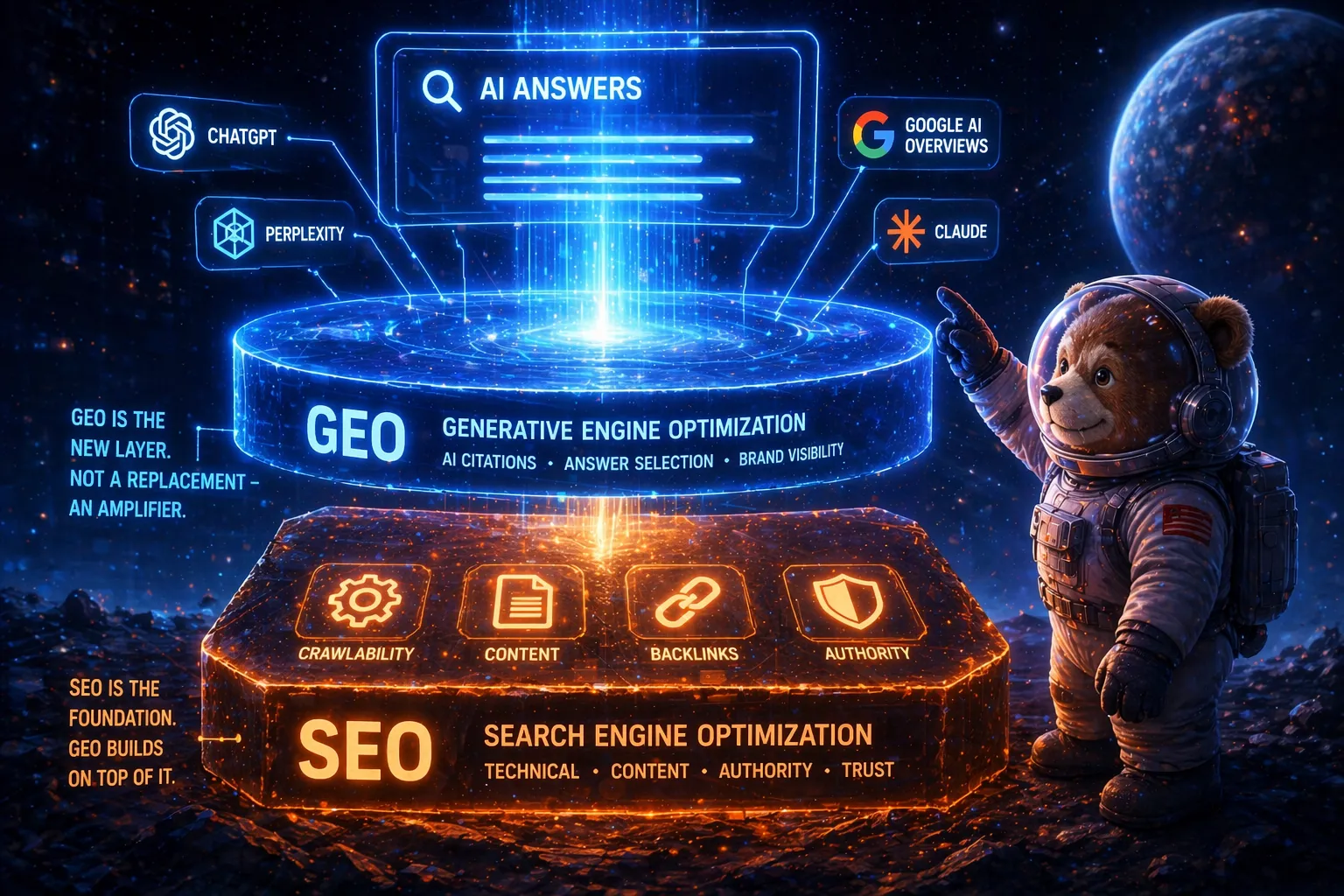
There’s a quiet shift happening in how people find products. A founder types “best AI marketing tool for startups” into ChatGPT instead of Google. A seed-stage team asks Perplexity to compare their options before booking a demo. A solo builder asks Gemini what tools are worth $50/month for GTM.
If you’re not in those answers, you don’t exist to those buyers.
That’s Generative Engine Optimization — GEO. And unlike traditional SEO, which rewards whoever has the most backlinks and the longest history, GEO is still early enough that a scrappy startup can show up ahead of a Series C competitor if they move fast and write smart.
Here’s how to do it.
What GEO Actually Is (and Isn’t)
GEO is the practice of optimizing your content and online presence so that AI-powered search engines — ChatGPT, Perplexity, Google’s AI Overviews, Gemini — surface your product, brand, or content in their responses.
It is not:
- A magic trick involving special tags or JSON-LD wizardry
- The same as ranking #1 on Google (though the two overlap)
- Something only enterprise companies with dedicated content teams can do
It is:
- About being a clear, credible, citable source on the topics your buyers are searching
- About writing the kind of structured, factual content that AI models love to quote
- About building enough topical authority that when someone asks “what’s a good tool for X,” your name comes up
Think of it this way: Google’s algorithm asks, “Who has the most authority?” AI search engines ask, “Who has the clearest, most useful answer?” As a founder, that second question is one you can actually win on.
Why This Matters Right Now
GTMfund put it bluntly in their 2025 outlook: “SEO is out, and GEO is in.” That’s hyperbole, but directionally correct. AI-generated answers are eating click-through rates on traditional search — users get the summary without clicking a link. The flip side? If your content is the source of that summary, you get the visibility, the authority signal, and sometimes the click anyway.
More importantly: the GEO landscape is not saturated yet. Enterprise SaaS companies are still writing 3,000-word SEO guides crammed with keywords. Most startup blogs haven’t heard of GEO. This is the window. First-movers in emerging keyword spaces almost always hold the position once AI models have indexed and synthesized the landscape.
The founders reading this in 2025 are in the same position as people who understood E-E-A-T before everyone else did in 2022. Early is an advantage.
The Four Principles of GEO for Founders
1. Write Answers, Not Articles
Traditional SEO content tries to be comprehensive. GEO content tries to be quotable.
AI models surface content that directly answers specific questions. That means your content should include:
- Clear, declarative statements (“The best way to X is Y, because Z.”)
- Structured comparisons with named alternatives (including competitors — this is scary but works)
- Definitions of terms your audience searches (“What is [concept]?”)
- Short, scannable lists over dense paragraphs
If you can’t find a sentence in your post that an AI model could lift and drop into a response, rewrite until you can. That sentence is your GEO hook.
2. Build Topical Depth on the Problems You Solve
AI search engines don’t just look at a single page — they assess whether a source consistently covers a topic well. This is called topical authority, and it matters for both traditional SEO and GEO.
For founders, this means publishing multiple pieces that cover your problem space from different angles:
- The problem itself (“Why founders waste 10 hours/week on GTM”)
- The category (“What is [your category]?”)
- The comparison (“Tool A vs. Tool B for startup marketing”)
- The how-to (“How to run your first [channel] campaign without an agency”)
- The opinion (“Why fully autonomous AI agents are a brand liability”)
You don’t need 50 articles. You need 8–12 pieces that signal you own the conversation around your niche. When an AI model has indexed five of your articles on the same topic, it starts treating you as a reference.
3. Be Mentioned Where AI Models Are Paying Attention
GEO isn’t just about your own site. AI models synthesize answers from across the web — Reddit threads, review sites, newsletters, podcasts, community posts. Your founder visibility in ChatGPT search isn’t just determined by your blog.
Practically, this means:
- Participate in communities where your buyers ask questions — Reddit, Indie Hackers, Hacker News, relevant Slack groups. Not as a promoter. As a genuinely helpful voice.
- Get mentioned in newsletters your ICP reads. A mention in a founder-focused newsletter gets indexed. It adds to the signal.
- Answer questions on Quora and Reddit with substance, not pitches. These rank in AI overviews constantly.
- Seek honest reviews on G2, Product Hunt, Capterra. AI models cite aggregator sites heavily.
The goal is to make your brand name appear in enough credible places that when someone asks a general question about your category, your product is part of the answer.
4. Use Structured, Specific Language (Not Marketing Speak)
This is where most founders trip up. Your homepage says “the all-in-one AI platform for growth.” Gemini optimization for startups doesn’t work with language like that — because no one searches for “all-in-one AI platform for growth.”
People search for specific things:
- “AI tool to manage Reddit marketing”
- “How to automate Google Ads for a small startup”
- “AI agent for content strategy under $100/month”
Your content needs to include the exact language your buyers use, including specific channel names, job titles, budgets, and tools. The more concrete your language, the more likely an AI model matches your content to a real query.
A useful exercise: write down the last five questions your target customer asked you in a sales call or support conversation. Turn each of those into a piece of content or a FAQ entry. That’s genuine GEO signal.
A Simple GEO Audit You Can Do This Week
You don’t need a consultant for this. Open ChatGPT, Gemini, and Perplexity and run the following queries:
- Your category — e.g., “best AI marketing tools for early-stage startups”
- Your problem — e.g., “how do founders do marketing without a CMO”
- Your competitor — e.g., “alternatives to [Competitor Name]”
- Your use case — e.g., “how to automate Reddit marketing for a startup”
Note what shows up. Note what doesn’t show up. If you see competitors in the answers and not yourself, read what they wrote. If you see no products mentioned at all — that’s a wide-open GEO gap you can fill with a single well-structured piece of content.
Do this quarterly. AI models update their training and retrieval sources regularly. GEO isn’t a one-time fix; it’s an ongoing signal game.
The Founder Shortcut: Answer the Questions No One Else Will
Enterprise content teams optimize for safe, generic topics. They will not write “Is [Category] Worth It for a Pre-Revenue Startup?” because it might cannibalize a sales lead.
You will. Because your whole brand is built on being direct with the exact founder who needs this.
That honesty is a GEO superpower. AI models surface opinionated, specific, trustworthy answers over safe, hedge-everything marketing copy. If you’ll actually tell founders when your product isn’t the right fit, when a competitor has a better feature for one specific use case, when a category is overhyped — you become the trusted voice in that space.
Trust is the currency of AI search. Spend it freely.
What This Looks Like in Practice
Here’s a practical 30-day GEO sprint for founders:
| Week | Action |
|---|---|
| 1 | Run the AI search audit above. Identify 3 gaps your competitors aren’t filling. |
| 2 | Publish one piece of content targeting the highest-value gap — written as an answer, not an article. |
| 3 | Post 3–5 substantive community replies on Reddit/HN/Indie Hackers that reference your content naturally. |
| 4 | Find one newsletter or publication your ICP reads and pitch a guest post or mention. |
Repeat. In 90 days you’ll start seeing your brand name appear in AI-generated answers. In 6 months, you’ll own a slice of the conversation in your category.
The Bottom Line
GEO is not a replacement for SEO — it’s what SEO evolves into when the search interface becomes a conversation. The fundamentals are the same: be credible, be specific, be genuinely useful. The tactics are slightly different: write for citation, not for clicks; build topical depth, not keyword breadth; appear in the places AI models actually read.
Most of your competitors haven’t thought about this yet. Some won’t for another two years. That’s the window.
Show up now, while the landscape is still being written — and let the AI models do the rest of the marketing for you.
Spacebear’s AI agents monitor your brand mentions, surface content opportunities, and help you execute across channels — all with human-in-the-loop approval so nothing goes live you haven’t signed off on. See how it works →