There’s a version of the AI marketing pitch that sounds genuinely compelling: deploy a fleet of autonomous agents, walk away, and wake up to a full pipeline. No approvals. No babysitting. Pure leverage.
And there’s a version of that story that ends with your brand account posting something deeply weird at 3am while you’re asleep.
Both are real. The difference — the only difference that actually matters when you’re a founder with a reputation to protect — is whether you kept a hand on the wheel.
The Automation Ceiling Nobody Talks About
Agentic AI is the real deal. Gartner projects that 40% of enterprise applications will embed AI agents by the end of 2026. Agentic spending is on track to hit $201.9B. This isn’t hype that’s about to correct — it’s the actual direction of the software industry.
For founders doing GTM without a dedicated marketing hire, the promise is obvious. You can’t be everywhere at once. Reddit threads go cold in hours. Google Ads need constant tuning. SEO content compounds over months, not weeks. A human-in-a-box approach — you, manually doing all of it — doesn’t scale past the first six months without something breaking.
So automation makes sense. The question is: how much of it runs without you?
Most of the “AI CMO” products launching right now have a clean answer: all of it. Set a brief, flip the switch, trust the machine. It’s a compelling positioning. It’s also quietly dangerous for anyone whose brand is still fragile — which, if you’re pre-Series A and not yet a household name, is everyone.
What Fully Autonomous Actually Means for Your Brand
When an AI agent operates without a human checkpoint, it’s making judgment calls you haven’t reviewed. In a controlled, well-scoped task — running a bid adjustment, reformatting a piece of content — that’s probably fine. The downside is bounded.
In the wild, unstructured environment of community channels? The downside is much less bounded.
Hacker News and Reddit are founder-to-founder spaces. The communities there have extraordinarily sensitive radar for anything that reads as promotional, off-tone, or scripted. A comment that’s 90% accurate but strikes the wrong register doesn’t just fail — it actively damages trust. You can’t unsend it. You can’t un-downvote it. The thread is already moving on without you.
A fully autonomous agent optimizes for engagement signals it can measure. It does not optimize for the intangible, highly contextual thing that is your brand voice — because your brand voice only fully lives in your head.
As Adweek put it when evaluating AI’s role in marketing: “As AI scales execution, leadership judgment becomes the primary differentiator.” That’s not a hedge. That’s the actual competitive moat founders have over automated-first competitors who’ve abdicated judgment entirely.
The Case for Human-in-the-Loop — and Why It’s Not a Compromise
The phrase “human-in-the-loop” gets framed as a limitation. Like you’re buying a slower, more manual version of automation because you’re not ready to trust the robots.
That framing is wrong.
Human-in-the-loop AI isn’t automation with training wheels. It’s a fundamentally different architecture — one where the agent handles the work (research, drafting, opportunity-spotting, bid calculations) and you handle the judgment (does this go out, does it match the tone, does this represent us well right now).
The distinction matters more than it sounds. Here’s what that loop actually buys you:
Speed without recklessness. Your agents are monitoring channels 24/7, surfacing opportunities in real time, and drafting responses faster than you could. You’re not in the production loop — you’re in the approval loop. That’s a one-second tap, not a thirty-minute writing session.
Brand safety without micromanagement. Nothing goes live that you haven’t seen. Full stop. You set the brief once, the agents work continuously against it, and anything that needs to go external hits your queue first. You’re not reviewing every keyword bid — you’re reviewing every piece of copy that touches your audience.
Compounding institutional knowledge. The more you approve, reject, and annotate, the sharper the agent’s calibration to your actual voice. You’re not training a generic model. You’re training your GTM system. That’s an asset that gets more valuable over time.
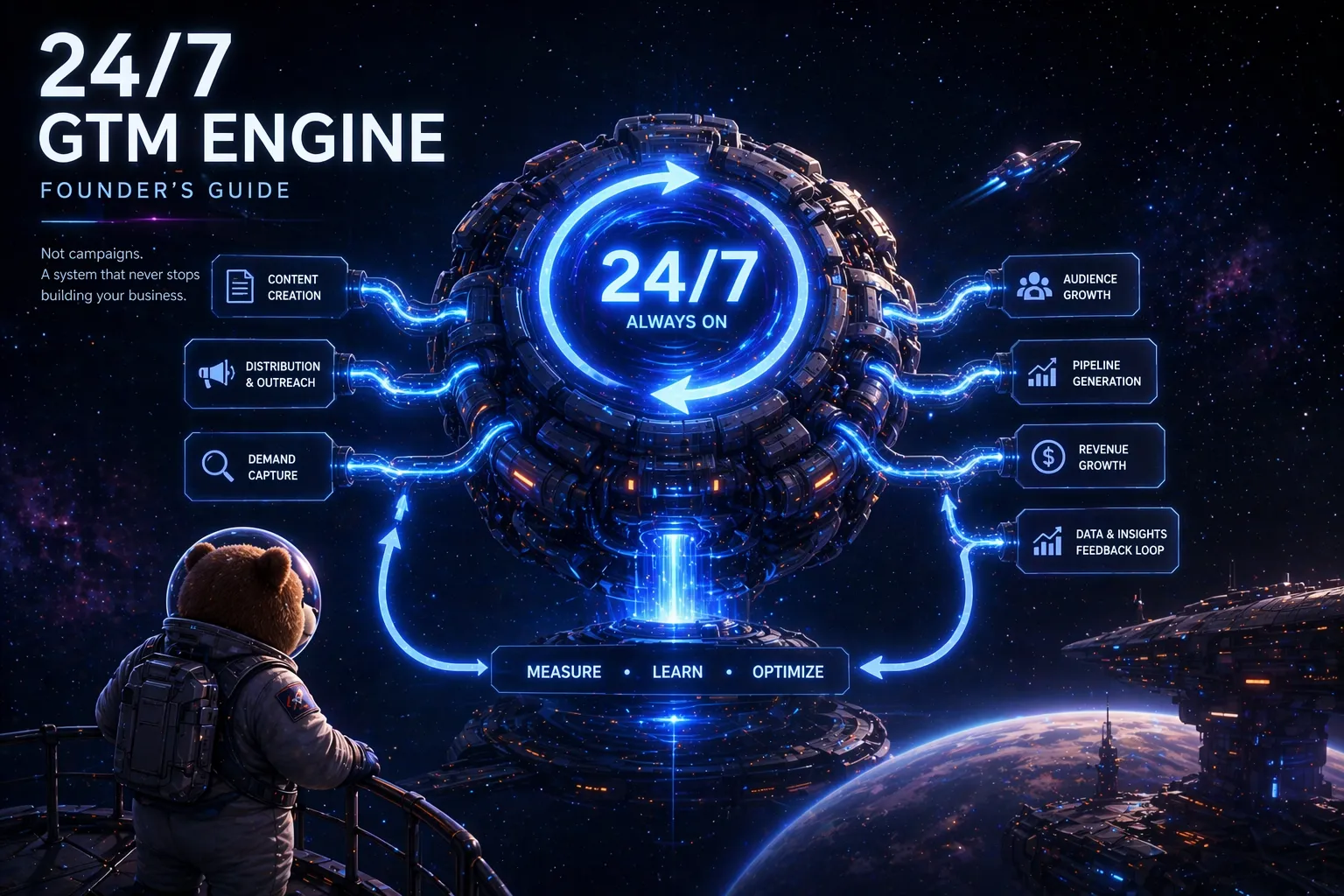
What a Real 24/7 GTM Engine Looks Like
Here’s what “24/7 marketing without ghost posts” actually looks like in practice for a solo founder or a small team:
Reddit & Hacker News — Agents monitor threads relevant to your product, surface high-signal opportunities (someone complaining about the exact problem you solve, a thread asking for recommendations in your category), and draft a response. You review it, tap approve, it posts. You were asleep. The thread was caught within the window where engagement still mattered.
Google Ads — Agents track performance against targets, identify underperforming ad groups, flag anomalies, and surface recommended changes with reasoning attached. You approve or reject with context. Nothing shifts budget without your sign-off. The tuning happens continuously, not in your monthly “I should probably look at this” review.
SEO & Content — Agents identify keyword gaps, draft briefs, write long-form pieces, and surface them for your review. You’re editing, not generating from scratch. The pipeline fills without you being the bottleneck.
Across all of it — your brief is the source of truth. Agents don’t freelance outside of it. They work within your positioning, your tone, your defined channels, and your defined goals. And they flag anything that feels like a judgment call rather than making it for you.
This is GTM automation for founders that actually holds up at scale — not because it removes you from the equation, but because it puts you exactly where your judgment is most valuable.
The Autonomy Trap
There’s a reason fully autonomous tools are appealing: they promise zero marginal effort. Write the brief, never touch it again.
But founders who’ve built anything know that zero marginal effort is a fantasy with customer-facing output. Your market changes. Your positioning sharpens. A competitor does something you need to respond to. A category narrative shifts and your messaging needs to move with it.
Fully autonomous agents don’t catch those shifts unless you’ve explicitly trained them to. And by the time you’ve noticed the drift and corrected it, the damage to your positioning — the weird posts, the off-brand replies, the ads that stopped matching your landing page — has already compounded.
The control that looks like a cost upfront is actually a protection mechanism. Founders who treat judgment as a competitive input — not a bottleneck — are the ones whose AI-assisted GTM motions actually hold up.
Where to Start if You’re Pre-Marketing-Hire
If you’re running GTM yourself right now, the leverage play isn’t to hand everything to a fully autonomous system. It’s to identify where your time is the bottleneck versus where your judgment is the bottleneck — and automate accordingly.
Most of the work in GTM is production work: writing first drafts, monitoring channels, pulling performance data, identifying opportunities. All of that can be handed to specialist agents operating 24/7. You stay in the loop for the decisions that actually shape how your brand shows up in the world.
That’s the architecture that scales. Not because it does everything for you — but because it does the right things without you, and keeps you in the chair for the ones that matter.
The goal isn’t to build a GTM engine that runs without a founder. It’s to build one that runs at founder judgment speed — which, it turns out, is much faster than doing it all manually.
Spacebear deploys specialist AI agents across your marketing channels — Reddit, Google Ads, SEO, Hacker News, and more. Every agent works 24/7. Nothing goes live without your approval. Start your free 7-day trial →