The AI marketing landscape has a terminology problem.
Every tool claims to be “AI-powered.” Your email platform has AI subject line suggestions. Your ad manager has AI bid optimization. Your social scheduler has AI caption generation. But despite all this AI, you’re still the one driving.
That’s because most of what’s marketed as “AI” in the GTM space is actually AI assistance — reactive features that wait for you to do something, then help you do it slightly better. They’re useful. But they’re not the paradigm shift that founders actually need.
The reactive vs. proactive divide
Here’s a simple way to think about it:
AI Assistants respond to your actions. You open a tool, start a task, and the AI helps you complete it faster. Examples:
- “Generate 5 subject line variations for this email”
- “Suggest a bid adjustment for this keyword”
- “Rewrite this LinkedIn post for better engagement”
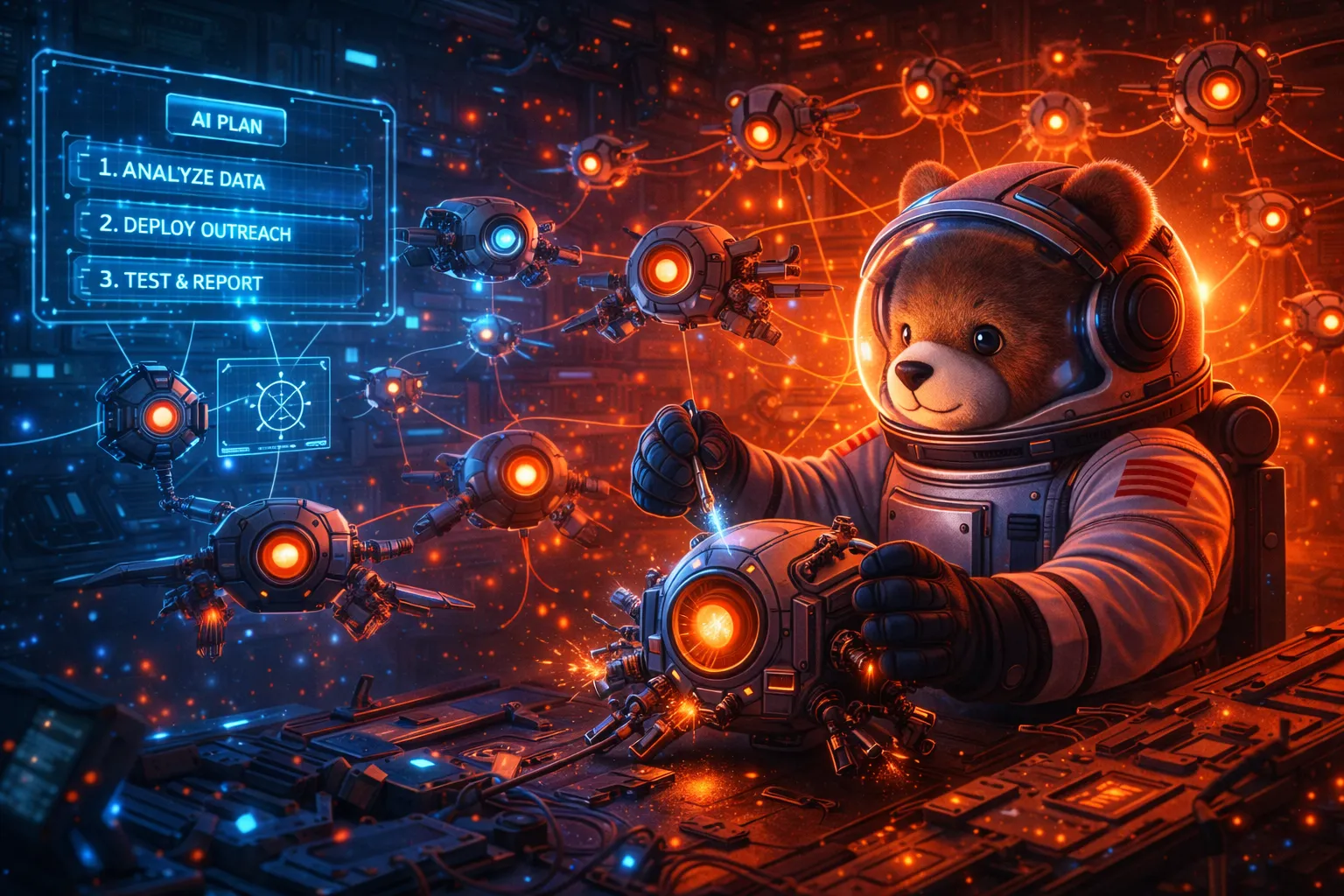
AI Agents act on your behalf. They monitor, analyze, decide, and execute — within boundaries you define — without waiting for you to initiate. Examples:
- Scanning 15 subreddits overnight and flagging 3 threads worth responding to
- Pausing an underperforming ad group at 2am because CPA exceeded your threshold
- Drafting a response to a Hacker News thread about your competitor, ready for your review when you wake up
The distinction matters because it determines who carries the cognitive load. With assistants, you’re still the project manager. With agents, you’re the decision-maker.
Why assistants hit a ceiling
HubSpot’s 2025 State of Marketing report found that marketers using AI assistants saved an average of 12 minutes per task — a meaningful improvement. But the same report found that the total number of marketing tasks didn’t decrease. It increased by 23%.
This is the assistant paradox: by making each task faster, AI assistants actually encourage you to do more tasks. The efficiency gains get absorbed by increased throughput, and you end up just as busy — you’re just busier faster.
For a solo founder or a small team, this is the wrong optimization. You don’t need to write LinkedIn posts 12 minutes faster. You need to not write them at all — while still getting the results.
The agent model
True AI agents operate more like a remote team member than a feature in a tool. They have:
- Persistent context — they remember your product, your audience, your tone, and your goals across sessions
- Autonomous monitoring — they continuously scan for relevant signals without being prompted
- Judgment — they can assess whether a Reddit thread is worth responding to, whether an ad keyword is bleeding money, or whether a LinkedIn post fits your brand voice
- Proactive action — they draft, recommend, and (with your approval) execute
This isn’t theoretical. Gartner already predicts that 60% of brands will use agentic AI for one-to-one customer interactions by 2028, and their 2025 CEO survey found that 29% of CEOs are already building strategies around AI agents. The shift from “AI that helps you work” to “AI that works for you” is already underway.
The trust problem (and how to solve it)
The biggest objection to AI agents is trust. And it’s valid.
If an AI assistant writes a bad subject line, you catch it before you click send. If an AI agent posts a tone-deaf comment on Reddit at 3am, the damage is done before you wake up.
This is why the human-in-the-loop pattern is non-negotiable for agent-based marketing. The agent should be able to do everything up to the point of action — monitor, analyze, draft, recommend — and then pause for human approval on anything that’s public-facing.
Think of it like a pull request workflow in software development. Your CI pipeline runs tests, linting, and security scans automatically. But the merge still requires a human reviewer. The automation handles the heavy lifting; the human provides judgment and accountability.
Research from MIT Sloan shows that human-AI teams outperform either working alone — but only when the division of labor plays to each side’s strengths. Agents handle volume, pattern recognition, and monitoring. Humans handle brand judgment, relationship nuance, and strategic decisions.
What this looks like in practice
Here’s a day in the life of a founder using AI agents vs. AI assistants:
With assistants:
- 8:00am — Open Reddit, scan 5 subreddits manually, find 2 relevant threads
- 8:30am — Open ChatGPT, ask it to draft responses
- 8:45am — Edit and post responses
- 9:00am — Open Google Ads, review campaign performance
- 9:20am — Ask AI to suggest bid adjustments, review and apply them
- 9:45am — Open LinkedIn, ask AI to draft a post, edit and schedule it
- Total: ~2 hours of active work before you’ve touched your actual product
With agents:
- 8:00am — Open Spacebear dashboard. Chief has a summary: Scout found 4 Reddit threads overnight (2 flagged as high-priority), Quinn paused a keyword that was bleeding money, and there’s a draft LinkedIn post ready for review
- 8:10am — Approve 2 Reddit responses, tweak 1, skip 1. Confirm Quinn’s budget reallocation. Approve the LinkedIn post.
- 8:20am — Done. Open your IDE.
- Total: ~20 minutes of decision-making
Same outcomes. Ten percent of the time.
The channel-native advantage
Not all agents are created equal. A generic “marketing AI” that tries to handle every channel with the same model is going to produce generic results.
Reddit has different norms than LinkedIn. Google Ads requires different expertise than email outbound. A thread on Hacker News demands a completely different tone than a post on r/Entrepreneur.
This is why Spacebear deploys separate, specialized agents for each channel. Scout understands Reddit karma dynamics and subreddit culture. Quinn knows the difference between broad match and phrase match. Each bear is tuned for its platform — not a general-purpose chatbot wearing a different hat.
Where this is heading
The assistant-to-agent transition in marketing is following the same trajectory as DevOps. We went from manual deployments to CI/CD to fully automated pipelines with human approval gates. Nobody would manually deploy to production today. In a few years, manually monitoring Reddit and adjusting Google Ads bids will feel equally antiquated.
The founders who adopt agent-based GTM now won’t just save time — they’ll compound the advantage as the technology improves. Every week of data makes the agents smarter. Every approved response trains better judgment. It’s an investment that gets cheaper over time, not more expensive.
Your marketing stack shouldn’t wait for you to show up. Spacebear deploys AI agents that monitor, draft, and act across your channels — while you focus on building.